Windows 10 End of Support: what UK businesses must know
Windows 10 support officially ended on 14 October 2025. Yet 42.7% of Windows users still run the outdated system as of November 2025. This isn’t just an IT problem. It’s a business survival issue. All UK organisations face three immediate threats: security breaches, compliance failures, and insurance invalidation. The deadline has passed, and the risks are real. Now is the time to act.
What security threats are users currently facing?
The threat landscape for UK organisations has moved from opportunistic vandalism to professionalised, financially motivated crime. Right now, the single biggest threat vector we see is human error exploited by increasingly sophisticated phishing and social engineering.
Attackers now use AI tools to craft hyper‑realistic phishing emails that mimic senior directors or trusted UK suppliers. These messages often bypass traditional email gateways. Criminals are no longer chasing quick ransoms; they are hunting for credentials that give them long‑term access.
For organisations, this typically results in two outcomes. First, double‑extortion ransomware, where data is stolen before being encrypted. This is a direct threat to GDPR compliance. Second, supply‑chain attacks that exploit smaller UK businesses as entry points into larger enterprises. If an SME becomes the ‘weak link’ that compromises a major client, the reputational damage is often terminal.
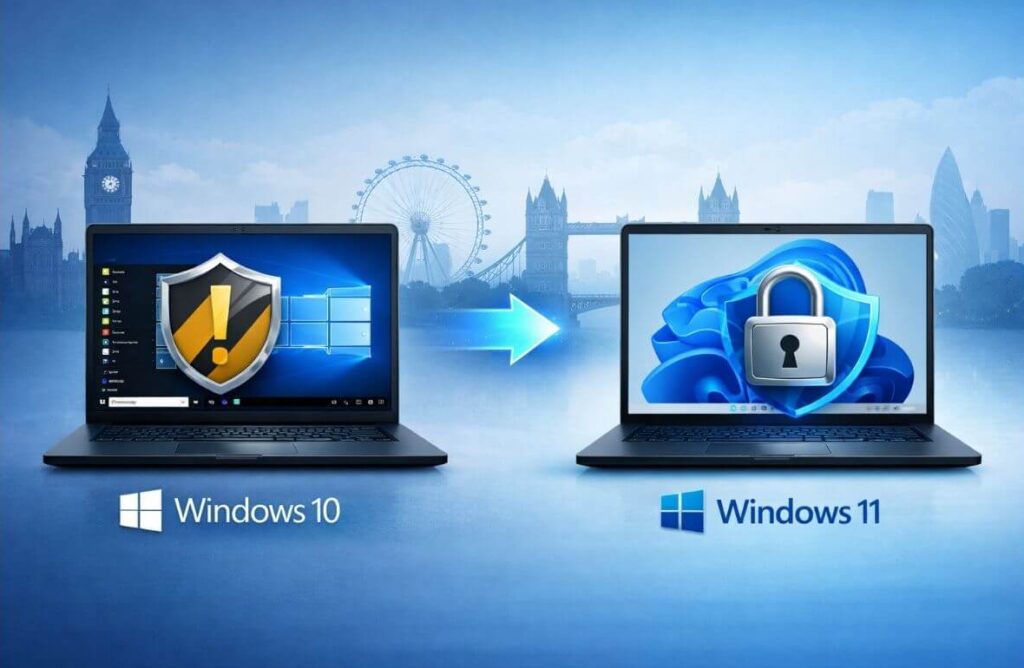
What happens if users don’t upgrade from Windows 10?
Come 14th October 2025, Windows 10 doesn’t stop working, but it does become immediately hazardous. When Microsoft stops issuing security patches, any new vulnerability discovered after that date remains open forever.
“Even a single Windows 10 device on your network creates an exploitable gap. The deadline has passed. The risks are real.” Share on XFor a UK organisation, continuing to use Windows 10 post-2025 isn’t just an IT issue; it’s a critical business risk with three immediate consequences:
It becomes an open door for attackers:
Hackers actively reverse-engineer updates for newer operating systems to find flaws in unpatched older ones. An unpatched Windows 10 machine on a network is a ticking time bomb. Even a single Windows 10 device on your network creates an exploitable gap. Attackers only need one unpatched endpoint to compromise an entire organisation.
Compliance failure:
Under GDPR, businesses must take ‘appropriate technical measures’ to secure data. Running unsupported software almost certainly fails this test. Furthermore, you will likely fail Cyber Essentials accreditation, which is increasingly required to tender for public sector or large corporate contracts in the UK.
Insurance invalidation:
Many cyber insurance policies now mandate supported software as a condition of coverage. If you are breached via an outdated OS (such as Windows 10), your insurer may refuse to pay out.
What significant support differences are in Windows 11 and not in Windows 10?
Windows 10 was built for a pre‑pandemic world back in 2015, while Windows 11 is designed for today’s hybrid working reality. The most important change isn’t cosmetic, it’s security.
Windows 11 mandates hardware‑backed security features such as TPM 2.0 (Trusted Platform Module). This means security is rooted in the device’s silicon rather than relying solely on software. It significantly strengthens identity protection, encryption, and resistance to malware tampering during the boot process. It’s also the reason why some older laptops and desktops cannot upgrade: they lack TPM 2.0 or do not meet the minimum memory and processor requirements.
Key Windows 11 security advantages include:
Hardware‑rooted security through TPM 2.0, making credential theft and boot‑level tampering far harder.
Secure Boot enforcement, preventing unauthorised or malicious code from loading during startup.
Virtualisation‑based security (VBS) and Hypervisor‑protected Code Integrity (HVCI), isolating sensitive processes from malware.
Stronger identity protection via Windows Hello for Business and enhanced Credential Guard.
Improved ransomware defence through controlled folder access and stronger attack surface reduction rules.
Better cloud‑native management with Microsoft Intune, enabling consistent patching, policy enforcement, and remote device control across hybrid workforces.
For managed service providers such as Northdoor, Windows 11’s deeper integration with cloud management tools like Microsoft Intune allows us to secure, patch, and manage an SME’s entire device fleet far more effectively than was possible with Windows 10, whether staff are in the office or working remotely.
How many UK users still rely on Windows 10?
The numbers are alarmingly high given the deadline has passed.
According to Statcounter, 42.7% of Windows users globally still run Windows 10 as of November 2025. Research by Which? suggests approximately 21 million people in the UK use Windows 10. This translates to millions of business devices at risk across all sectors.
Why the lag?
The primary reason is the hardware barrier. Windows 11 has stricter processor requirements. It demands TPM 2.0 compatibility.
Many organisations realise upgrading the OS means buying entirely new laptop fleets. With current economic pressures, this represents a significant capital investment.
Some businesses hope Microsoft will defer the deadline again. This is wishful thinking. The deadline has now passed.
The technical debt time bomb
Many UK organisations delayed hardware refreshes due to economic concerns. Now they face a significant capital outlay and a complex migration simultaneously.
This isn’t just about buying new hardware. It’s about planning, testing, and executing a complete system transition.
Your next steps: secure your business now
The Windows 10 end of support deadline has passed. Every day you delay increases your risk.
Here’s what you need to do:
- Audit your current estate: Identify every Windows 10 device
- Assess hardware compatibility: Determine which machines can upgrade to Windows 11
- Plan your migration timeline: Create a realistic upgrade schedule
- Budget for new hardware: Some devices will need replacement
- Engage a managed service provider: Professional support ensures smooth transition.
How Northdoor can help
At Northdoor, we help UK organisations of all sizes manage this critical transition. We assess your current infrastructure. We identify upgrade paths. We manage the entire migration process.
Don’t let outdated software become your business liability. Contact our team today to discuss your Windows 11 migration strategy or for a free security assessment.
Press coverage: