Resources Download Form
Complete this form to download our resources. Once you have submitted it, all other resources can be downloaded without having to complete another form again.
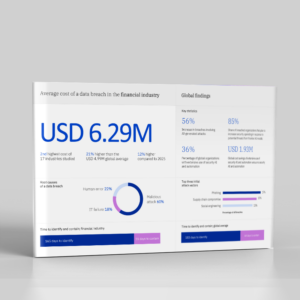
The average cost of a data breach in the financial services sector reached USD 6.29 million in 2026, 26% above the USD 4.99 million global average and the second-highest cost of the 17 industries studied. Breach costs in the sector are up 12% on 2025.
Discover how security AI and automation, faster detection and containment, and a tighter grip on third-party risk are associated with lower breach costs across financial services.
IBM’s Cost of a Data Breach Report 2026 examines the financial services sector specifically, revealing the threat landscape facing banks, insurers and financial firms worldwide. The result is a sector-focused view offering targeted insights for security and business leaders, directly relevant to an industry already under sustained regulatory and threat pressure from DORA, NIS2 and GDPR.
2026 financial services insights
The report signals a shift: breach costs in financial services aren’t just high, they’re rising faster than the market as a whole. Meanwhile, the tools available to bring those costs down, security AI, automation and tighter identity controls, are still used by only a minority of organisations globally.
For security and business leaders in financial services, that gap is the opportunity. This report gives CISOs, CIOs and risk and compliance teams the benchmarks to justify investment and the specifics to know where to target it first.
This report reveals:
Cost and impact
- The financial services sector’s average breach cost, and how it compares with 17 other industries.
- The scale of the year-on-year increase in sector breach costs.
- The cost saving associated with extensive use of security AI and automation.
Attack vectors and AI-generated threats
- The top three initial attack vectors affecting financial services organisations.
- The global rise in breaches involving AI-generated attacks.
- The share of breached organisations increasing security spend specifically because of frontier AI threats.
Detection, response and AI automation
- How long financial services organisations take to identify and contain a breach, and how that compares with the global average.
- The proportion of organisations globally with extensive security AI and automation deployment.
- Why the gap between “faster than average” and “fast enough” still matters for regulatory reporting windows.
Security technologies and organisational practices
- The root causes behind breaches in financial services: malicious attack, human error and IT failure.
- IBM’s recommendations for the year ahead, including AI sovereignty, application and API security, and continuous, risk-based identity verification covering human and non-human identities.
For more insight, read our blog. IBM’s 2026 data breach report: what it means for financial services
Access the most up-to-date intelligence on data breach costs in financial services
Ready to strengthen your cyber defences? Download the full report findings and talk to us about what they mean for your organisation.
Subscribe to our newsletter
Subscribe to our newsletter to get the very latest insights and updates in the world of enterprise IT and data security: